Direct control of relays or switches
It is possible to directly control relays or switches through MQTT. You can use this to implement custom logic regarding the relays.
Modes: Device switching mode and external signal passthrough mode
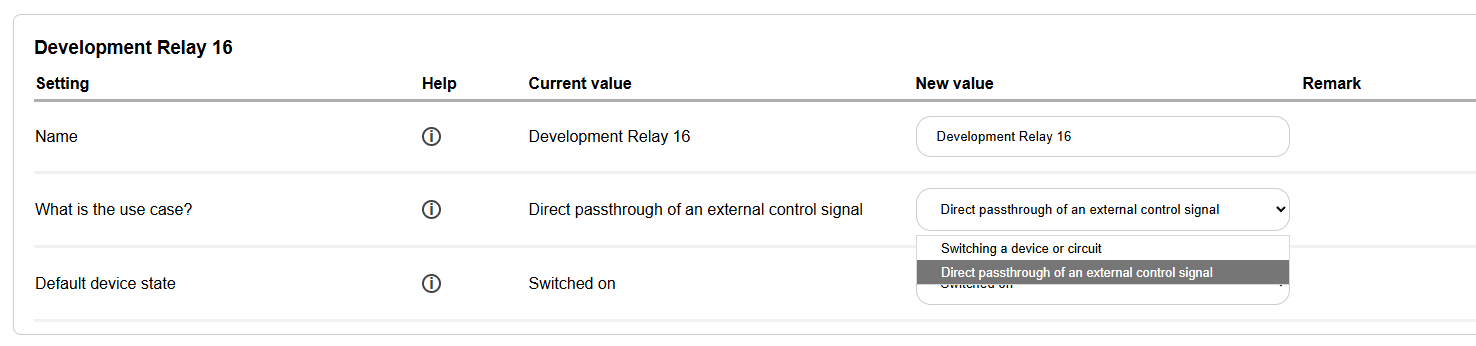
Each relay or switch can be configured to operate in device switching mode or external signal passthrough mode from the device settings of the relay or switch.
Device switching mode
When the relay or switch is in 'device switching mode', the SmartgridOne Controller will plan the relay as a load with a certain power that can be switch on and off. The SmartgridOne Controller will take power limits into account, but timing constraints are ignored when the relay is directly controlled through an external signal (they are taken into account only in local control without an external signal).
External signal passthrough mode
When the relay is in 'external signal passthrough mode', the SmartgridOne Controller will directly pass through the external control signals. No validation checks for limits or timing constraints are applied. This mode is solely intended for allowing to connect the relay or switch to an external third party device for further processing there, e.g. signaling a certain state. In absense of an external control signal, the default device state is applied.